

A quick google search will give you all sorts of different breastfeeding positions and techniques. Whichever, position you choose and find most comfortable, the way you align baby with you should always stay the same. If you take away anything from this article, I hope its Mama and baby: tummy-to-tummy, lining up baby’s hip, ear, and shoulder.

Always check baby's position!
Tummy-to-tummy refers to the positioning of the baby’s abdomen against the mother’s belly. This positioning allows for better access to the breast, ensuring a deeper latch, and efficient milk transfer, leading to a satisfying feeding experience. A good latch ensures that the baby is receiving enough milk and prevents any nipple soreness or damage.
When the baby’s tummy is directly in contact with the mother’s tummy, it aids digestion, reduces reflux, and provides a sense of security for the baby. Tummy-to-tummy in combination with skin to skin, also promotes the release of oxytocin, a hormone responsible for milk production and let-down reflex.
The next component, ear, shoulder, hip, refers to the alignment of the baby’s body during breastfeeding. The baby’s head should be in line with their body, with the ear, shoulder, and hip forming a straight line. This alignment ensures that the baby can latch onto the breast effectively, reducing the strain on the mother’s nipple and preventing any discomfort or pain during feeding. Let’s look at the benefits of proper alignment!
Do’s
-
Bring your baby to your breast. Never Breast to baby!
-
Cradle baby in your arm—tummy to tummy with you, lining up their ear, shoulder, and hip. If you can see the logo on your baby’s onesie, they are facing too far upward and will have a harder time achieving a comfortable deep latch. Imagine standing in front of a water fountain, but your body is facing to the right. It would be difficult to drink that way!
-
Move back 1-3 inches allowing baby to open their mouth very wide. Wait for baby to open their mouth wide, like a yawn. This is the optimal moment to bring baby to your breast, ensuring they take in as much of the areola (the dark area surrounding the nipple) as possible.
Don’t
-
Do not force the infant to the breast.
-
Do not place your hand behind their head, no one enjoys being shoved into their meal! There should be no pressure against the back of the infant’s head from the mother’s arm, hand, or pillow. Doing so prevents baby from being able to tilt their head back in order to gape and achieve a good latch. Instead, try supporting baby’s neck and lower part of their head.
Practical Breastfeeding Positions
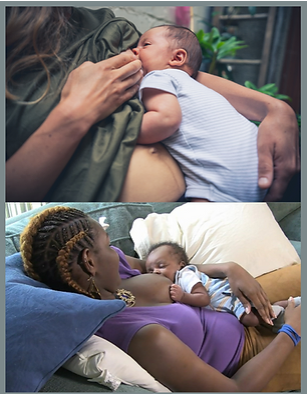
Laid-Back Breastfeeding
Also referred to as ‘biological nurturing’, capitalizes on the intuition and instincts of mama and baby.
In this position, the mother lies semi-reclined on her back, with baby lying tummy-to-tummy on top of her. This position not only stimulates the newborn’s reflexes but is helpful for mothers who have oversupply or an abundance of milk production. By lying in this position, it helps the milk slow down and not gush out quickly into baby’s mouth.
Cradle Hold
In this position, the mother sits with her infant’s body across her abdomen, while supporting the back of the baby’s head with her arm.
This hold is what many mothers use instinctively and the most common. This position promotes a straight line from your baby’s ear, shoulder, and hip, ensuring optimal digestion. It is also a great position for bonding and establishing eye contact with your baby.
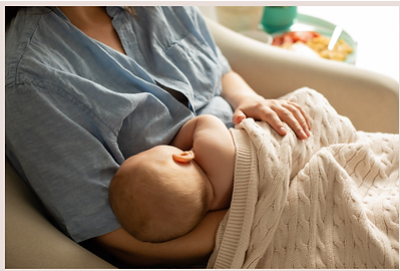
Side-Sitting Hold
In the side-sitting (also called football or clutch) hold, the mother places her baby under her arm, similar to how a women clutches a purse to her side or a football player holds the while running. The baby lies along her side with their feet towards the mother’s back. Pillows are usually used in this position to help support the baby and the mother’s arm.
Holding baby upright tends to wake a sleepy baby to eat, and many find that their baby nurses in this position best if not lying flat on their back, but angled up.
This position can be helpful for nursing a preterm infant, who fits under their mother’s arm. Also useful for baby’s who are having trouble latching or a mother who had cesarean birth or has larger breasts. It offers excellent support for both you and your baby, minimizing strain on your back, neck, and shoulders.
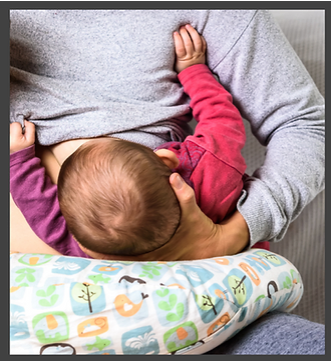

Cross-Cradle Hold
Cross-cradle hold combines the side-sitting hold and the cradle hold, so that the mother rests the infant’s head in her hand.
This position can allow a mother with a preterm or small baby, latch well enough to initiate sucking. Feeding this way can also be easier for the mother to manage, brining more confidence.
Side-Lying Nursing
This position is my personal favorite position to use in the early stages and for night nursing.
This position allows the baby to self-attach and gives the mother some much needed rest. To use this position, the mother lies on her side. Here she can either place her arm under the baby’s head or behind her own. She can also place her hand along the baby’s back. To nurse on the top breast, the mother can roll toward the baby or can roll to the opposite side.
Placing pillows under the mother’s head or in between her legs can also provide extra support for the mother.

Conclusion
By trying out different positions and seeing what works for both of you, you can feel confident in your ability to nurse your baby. What may work one breastfeeding session, may not the next. Remeber, there is no one right way to hold a baby! Only correct alignment. Overtime the baby will self-attach and nurse in a variety of positions, especially as baby get older. Older nurslings become “acrobatic” or perform “nursing gymnastics” in ways you would not imagine! Ha! Holds and positions are only tools for a mother, who can choose what is needed at that particular time.